What if your Meta Ads are generating clicks, impressions and enquiries, but your business is still not getting enough customers?
The problem may not be your budget.
It could be your strategy.
Many businesses spend money on Facebook and Instagram advertising without knowing which audience to target, what creative to test, how to structure their funnel or which metrics actually matter. The result is often the same: plenty of activity inside Ads Manager, but disappointing business results.
The good news? You do not always need to increase your budget.
You need a smarter system.
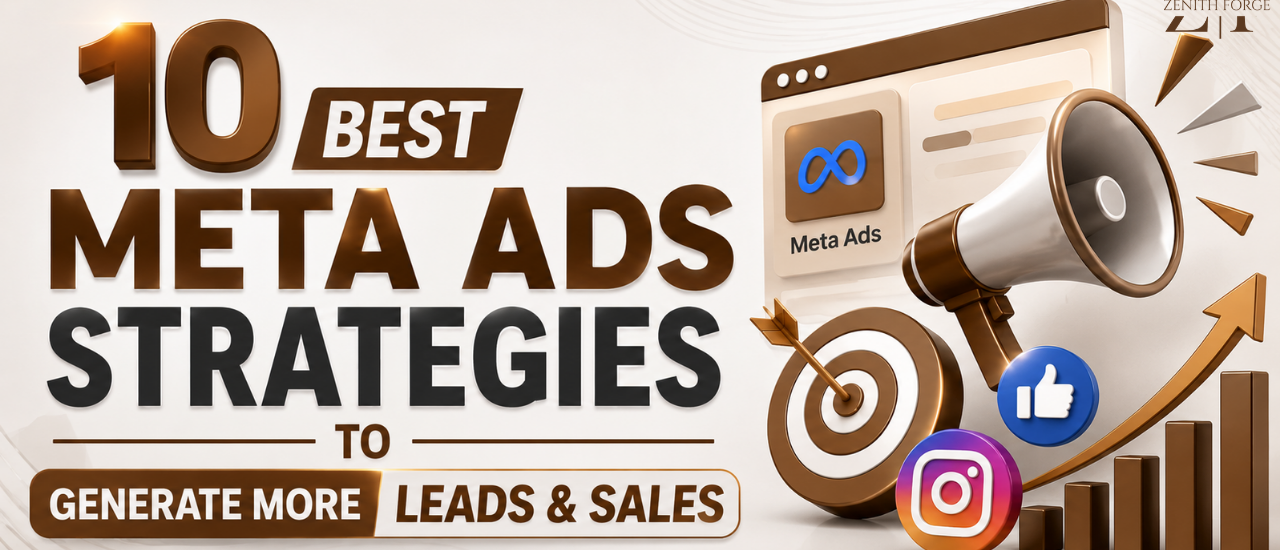
In this guide, we’ll cover 10 practical Meta Ads Strategies that can help businesses generate better leads, increase sales, reduce wasted ad spend and build campaigns that can scale sustainably.
These Meta Ads Strategies focus on audience relevance, creative testing, offers, conversion tracking, retargeting, landing pages and continuous optimisation—not shortcuts or “secret hacks.”
If you are new to Meta advertising, start with our complete Meta Ads guide to understand how the platform works before applying these strategies.
What Makes Meta Ads Strategies Actually Work?
Running an advertisement is easy.
Building a campaign that consistently contributes to revenue is much harder.
Effective Meta Ads Strategies connect the complete customer journey:
Audience → Creative → Offer → Landing Page → Conversion → Follow-Up → Revenue
If one part of this chain is weak, campaign performance can suffer.
For example:
- Great creative + wrong audience = wasted impressions
- Good targeting + weak offer = low conversions
- Quality traffic + poor landing page = lost leads
- Plenty of leads + poor follow-up = lost customers
- Good sales + poor margins = unprofitable advertising
That is why you should not judge Meta Ads only by likes, impressions or clicks.
The real question is:
Are these ads helping your business acquire profitable customers?
1. Choose the Right Campaign Objective
One of the most important Meta Ads Strategies is matching your campaign objective with the actual business goal.
If you want enquiries, build the campaign around lead generation.
If you want online purchases, optimise towards sales and purchase conversions.
If your objective is brand discovery, awareness may be more appropriate.
Match Your Objective With Your Goal
| Business Goal | Primary Focus |
|---|---|
| Generate enquiries | Leads |
| Sell products | Sales |
| Build awareness | Awareness |
| Drive useful website visits | Traffic |
| Increase interactions | Engagement |
| Promote an app | App promotion |
A common mistake is optimising for the easiest metric instead of the most valuable business outcome.
For example, 1,000 inexpensive clicks may look impressive. But if they generate only two customers, they may be less valuable than 300 targeted clicks that produce 20 qualified enquiries.
Business outcome > vanity metric.
2. Understand Your Customer Before Targeting
Before opening Ads Manager, understand the person you want to reach.
Ask:
- What problem are they trying to solve?
- What motivates them to buy?
- What objections stop them?
- What alternatives are they considering?
- What language do they use?
- What would make them trust your business?
Strong Meta Ads Strategies begin with customer understanding, not random audience targeting.
For example, a digital marketing agency targeting a local business owner should not communicate like it is speaking to a marketing professional.
Instead of:
“Our integrated performance marketing ecosystem improves acquisition efficiency.”
A business owner may respond better to:
“Get more qualified enquiries without wasting your advertising budget.”
The closer your message is to the customer’s real problem, the easier it becomes to create relevant advertising.
3. Make Creative Testing a Core Part of Your Strategy
Your audience cannot convert if your advertisement does not earn their attention.
That is why creative testing should be an ongoing part of your Meta Ads Strategies.
Test different:
- Hooks
- Videos
- Images
- Headlines
- Primary text
- Offers
- Testimonials
- CTAs
- Problem statements
- Product demonstrations
For example:
Ad A:
“Still struggling to generate quality leads?”
Ad B:
“Your competitors may be getting the customers you are missing.”
Ad C:
“Stop wasting money on ads that do not convert.”
The service can remain the same while the psychological angle changes.
A Simple Testing Cycle
Create → Test → Measure → Identify Winners → Improve → Test Again
Do not decide which advertisement is best simply because it looks better to you.
Let campaign data guide the decision.
For additional guidance, you can also refer to Meta’s official advertising resources.
4. Use Short-Form Video to Win Attention
Facebook and Instagram are highly visual platforms, so your creative needs to communicate quickly.
Short-form video can work particularly well for:
- Product demonstrations
- Service explanations
- Customer testimonials
- Before-and-after transformations
- Problem/solution content
- Founder-led videos
- Educational content
A simple video structure is:
0–3 Seconds: Hook
Give viewers a reason to stop scrolling.
3–10 Seconds: Problem
Show that you understand their challenge.
10–20 Seconds: Solution
Explain or demonstrate how you solve it.
Final Seconds: CTA
Tell them exactly what to do next.
For example:
“Need more leads from your website? Here is why your current ads may not be converting.”
Then explain the problem and finish with:
“Book a free consultation.”
Do not make every creative feel like a traditional advertisement. Educational and problem-solving content can communicate value more naturally.
5. Do Not Overcomplicate Your Audience Targeting
More targeting options do not automatically mean better targeting.
One of the common mistakes in Meta Ads Strategies is creating too many small audience segments before enough data has been collected.
For example, a business may create separate audiences for:
- SEO
- Digital marketing
- Google Ads
- Facebook marketing
- Online advertising
- Social media marketing
This can create unnecessary fragmentation.
Instead, start with sensible audience structures and allow enough room for the platform to identify potential converters.
Broad targeting does not mean ignoring your customer profile.
You still need to understand:
- Location
- Customer type
- Relevant demographics
- Buying behaviour
- Business category
- Offer relevance
Strong creative + clear offer + relevant audience + reliable conversion signals create a stronger foundation.
6. Build Retargeting Into Your Funnel
Not everyone buys the first time they see your advertisement.
A potential customer might:
- See your Instagram ad
- Visit your website
- Read your service page
- Leave without contacting you
- See your advertisement again
- Return later
- Finally submit an enquiry
That is why retargeting is an important part of many Meta Ads Strategies.
You can build audiences around previous interactions such as:
- Website visitors
- Instagram engagement
- Facebook engagement
- Video viewers
- Previous leads
- Product viewers
- Cart abandoners
The message should also change based on audience awareness.
Cold Audience
“Looking for a better way to generate leads?”
Retargeting Audience
“Already explored our services? Let’s discuss the right strategy for your business.”
The second message assumes familiarity and can therefore be more direct.
7. Give People a Reason to Take Action
Your advertisement needs more than a generic “Contact Us” button.
You need an offer that gives people a reason to act.
Depending on your business, this could be:
- Free consultation
- Free audit
- Free strategy session
- Product demonstration
- Free quotation
- Introductory offer
- Downloadable guide
For example:
Weak CTA:
“Contact us for digital marketing.”
Stronger Offer:
“Get a Free Digital Growth Consultation.”
The second option communicates a clearer benefit.
However, never use unrealistic claims simply to increase conversions.
Avoid claims such as:
- “Guaranteed #1 ranking”
- “100% guaranteed sales”
- “10X revenue guaranteed”
- “Instant results guaranteed”
unless they can genuinely be substantiated.
Trust is a major part of sustainable advertising.
8. Make Your Landing Page Match Your Advertisement
Imagine clicking an advertisement that promises:
“Get a Free Website Audit.”
But the landing page simply says:
“Welcome to Our Digital Marketing Agency.”
There is a disconnect.
The visitor now has to figure out what to do next.
A good Meta Ads Strategy should maintain message consistency between the advertisement and landing page.
If the ad promises an audit, the landing page should immediately explain:
- What the audit includes
- Who it is for
- What the visitor receives
- Why they should trust you
- How to request it
A Conversion-Focused Landing Page Should Include
- Clear headline
- Strong value proposition
- Relevant supporting information
- Social proof
- Trust signals
- Simple CTA
- Mobile-friendly design
- Short and relevant form
Do not automatically send every advertisement to your homepage.
A dedicated landing page aligned with the campaign objective can provide a clearer conversion path.
Businesses looking for support across paid advertising, SEO, websites and digital growth can explore Zenith Forge’s digital marketing services.
9. Measure Leads, Sales and Profit—Not Just Clicks
A campaign can look successful inside Ads Manager while producing poor business results.
That is why measurement should go beyond impressions and clicks.
Important metrics include:
CTR — Click-Through Rate
Shows how effectively your creative and message encourage clicks.
CPC — Cost Per Click
Shows how much you are paying for each click.
CPL — Cost Per Lead
Important for lead-generation campaigns.
CPA — Cost Per Acquisition
Measures the cost of acquiring a desired conversion or customer.
Conversion Rate
Shows how effectively your traffic converts.
ROAS — Return on Ad Spend
Helps evaluate revenue generated relative to advertising spend.
For example:
Ad Spend = ₹20,000
Attributed Revenue = ₹80,000
ROAS = 4X
But 4X ROAS does not automatically mean 4X profit.
You also need to consider:
- Product or service margins
- Fulfilment costs
- Sales costs
- Discounts
- Refunds
- Operational expenses
- Customer lifetime value
Revenue is not the same as profit.
This is one of the most important principles behind effective Meta Ads Strategies.
10. Optimise and Scale Based on Evidence
Launching a campaign is not the finish line.
It is the beginning of the learning process.
A practical optimisation loop looks like this:
Launch → Collect Data → Analyse → Identify Winners → Reduce Waste → Test → Scale → Repeat
Avoid changing everything at once.
If you simultaneously change the:
- Audience
- Budget
- Creative
- Offer
- Landing page
- Campaign structure
you may not know which change affected performance.
Instead, test systematically.
Example
Test 1: Same audience + different hooks
Test 2: Same creative + different offers
Test 3: Same offer + different landing pages
This creates clearer learning and makes optimisation easier.
Remember:
Scaling is not simply increasing the budget.
Scale only when the campaign is producing results that make financial sense for the business.
Meta Ads Performance Funnel
A campaign should be analysed as a complete customer journey:
Impressions
↓
Clicks
↓
Website Visit
↓
Lead
↓
Qualified Lead
↓
Customer
↓
Revenue
This funnel helps identify where the actual problem exists.
High Impressions + Low Clicks
Look at your creative, hook and messaging.
High Clicks + Low Leads
Look at your landing page, offer and conversion path.
High Leads + Low Sales
Look at lead quality, pricing and sales follow-up.
High Sales + Low Profit
Look at customer acquisition cost, margins and unit economics.
This approach is much more useful than simply saying, “My ads are not working.”
Meta Ads Strategies for Small Businesses
Small businesses do not always need complicated campaign structures.
A practical starting framework can include:
Prospecting
Reach new potential customers using:
- Strong hooks
- Problem/solution creatives
- Relevant audiences
- Clear offers
Retargeting
Reconnect with people who have already interacted with your business using:
- Testimonials
- Case studies
- FAQs
- Objection handling
- Offers
Conversion
As enough data becomes available, optimise towards the final business outcome.
Start simple.
Collect data.
Then improve based on what the data actually tells you.
Common Mistakes That Waste Meta Ads Budget
Even well-planned Meta Ads Strategies can fail because of poor execution.
Avoid:
- Boosting posts without a clear objective
- Running only one creative
- Constantly changing campaigns
- Optimising for cheap clicks instead of valuable actions
- Ignoring retargeting
- Sending traffic to an irrelevant page
- Using vague CTAs
- Making unsupported performance claims
- Over-segmenting audiences
- Scaling too quickly
- Ignoring lead follow-up
- Measuring only vanity metrics
The biggest lesson is simple:
A cheap lead is not necessarily a good lead.
If your sales team cannot convert those leads, reducing CPL alone will not solve the business problem.
How to Improve Meta Ads ROI
Improving ROI requires looking at the complete customer journey.
Better Hook
↓
More Attention
Better Creative
↓
More Relevant Traffic
Better Offer
↓
Higher Intent
Better Landing Page
↓
More Conversions
Better Follow-Up
↓
More Customers
Better Tracking
↓
Smarter Decisions
This people-first approach also supports strong E-E-A-T signals because useful advertising content should be based on genuine expertise, clear reasoning and trustworthy claims.
Google recommends creating helpful, reliable, people-first content and demonstrating who created the content, how it was produced and why it is useful. You can review Google Search Central’s guidance on helpful content for more detail.
The same principle is useful when creating content that may appear in AI-powered search experiences: provide clear answers, original insights, useful structure and information that genuinely helps the reader.
Meta Ads Checklist Before You Launch
Strategy
- Is the business goal clearly defined?
- Is the campaign objective aligned with that goal?
- Do you understand your target customer?
- Is your offer relevant?
Creative
- Do you have multiple creative concepts?
- Is the hook strong?
- Is the message easy to understand?
- Is the CTA clear?
Targeting
- Is your audience relevant?
- Are you avoiding unnecessary fragmentation?
- Have you considered retargeting?
Conversion
- Does the landing page match the advertisement?
- Is the page mobile-friendly?
- Is the form simple?
- Is the next action obvious?
Measurement
- Is conversion tracking configured?
- Are you monitoring CPL and CPA?
- Are you measuring qualified leads?
- Can you connect advertising results with actual sales?
Final Thoughts
The best Meta Ads Strategies are not about finding a secret targeting trick or copying another business’s campaign.
They are about building a complete system.
Right audience + right creative + right offer + right conversion path + accurate measurement = better advertising decisions.
If your goal is lead generation, do not optimise only for clicks.
If your goal is sales, do not stop at traffic.
And if your goal is growth, do not blindly increase your budget.
First, understand what is working.
Then improve it.
Then scale what makes financial sense.
When implemented with proper testing, tracking and optimisation, Meta Ads Strategies can become a powerful customer-acquisition framework for businesses that want measurable growth.
For broader digital growth support covering paid advertising, SEO, social media and website optimisation, explore Zenith Forge or contact our team.
Frequently Asked Questions
1. What are the best Meta Ads Strategies for generating leads?
The strongest approach combines a clear objective, relevant audience, strong creative, compelling offer, conversion-focused landing page, retargeting and accurate tracking.
2. How can Meta Ads generate more sales?
Focus on sales-oriented campaigns, relevant creatives, strong offers, retargeting and a smooth conversion journey. Measure actual purchases or qualified customers, not just clicks.
3. How often should I test Meta Ads creatives?
Creative testing should be continuous. Test different hooks, formats, messages and offers systematically instead of relying on one advertisement.
4. What is a good cost per lead for Meta Ads?
There is no universal good CPL. It depends on lead quality, conversion rate, customer value, profit margin and sales close rate.
5. Why are my Meta Ads getting clicks but no sales?
Clicks without sales can indicate problems with the offer, landing page, audience quality, tracking, pricing or sales follow-up. Analyse the complete funnel instead of blaming the advertisement alone.
Frequently Asked Questions
1. What are the best Meta Ads strategies for generating leads?
The strongest approach combines a clear campaign objective, relevant audience, strong creative, compelling offer, conversion-focused landing page, retargeting and accurate tracking. Lead quality should be measured alongside cost per lead.
2. How can Meta Ads generate more sales?
Focus on sales-oriented campaigns, strong product or service creatives, relevant offers, retargeting and a smooth conversion journey. Most importantly, measure actual purchases or qualified customers rather than relying only on clicks and engagement.
3. How often should I test Meta Ads creatives?
Creative testing should be continuous. Test different hooks, formats, messages and offers rather than relying on one advertisement for an extended period. Make changes systematically so you can understand which variables influence performance.
4. What is a good cost per lead for Meta Ads?
There is no universal “good” CPL. A ₹100 lead can be expensive for one business and highly profitable for another. The correct benchmark depends on lead quality, conversion rate, average customer value, profit margin and sales close rate.
5. Why are my Meta Ads getting clicks but no sales?
Clicks without sales can indicate a problem with the offer, landing page, audience quality, conversion tracking, pricing or sales follow-up. Analyse the complete funnel instead of assuming that the advertisement itself is the only problem.